Security model
Who can call what, how secrets are stored, and where the trust boundaries are. The detail behind each claim here is in the API reference; this page is the map.
Three kinds of caller, three mechanisms
They are separate on purpose. A password proves a human is who they say; a random key identifies a service; a proxy token says "I am a process in this deployment". Collapsing any two of them means one leak costs more than it should.
flowchart TB
    subgraph DP["data plane · :4000 · public"]
        direction TB
        C["client<br/>Bearer sk-…"] --> K["SHA-256 → principal<br/>401 if unknown or expired"]
        K --> G["model:invoke grant?<br/>403 if not"]
        G --> L["rate limit · budget<br/>429 · 402"]
        L --> U["forward upstream"]
    end

    subgraph AP["admin plane · :4001 · not public"]
        direction TB
        H["operator<br/>name + password"] --> S["Argon2id verify<br/>→ fastllm_session cookie<br/>HttpOnly · SameSite=Strict · 12h"]
        S --> P["per-route permission?<br/>403 if not"]
        P --> A["/admin/* · every write audited"]
        X["proxy process<br/>Bearer pt-…"] --> Y["/snapshot · /usage<br/>/limits/reconcile"]
    end

    U -.->|"never reaches"| AP
| caller | credential | verified with |
|---|---|---|
| A client calling the gateway | API key, sk-… | SHA-256 |
| A human using the admin UI | password → session cookie | Argon2id |
| A proxy replica talking to its control plane | --proxy-token | constant-time compare |
Keys hash with SHA-256, passwords with Argon2id, and that difference is deliberate. An API key is high-entropy random, so the only attack is stealing it and a fast hash costs nothing; a password is low-entropy and human-chosen, so it needs a hash that is slow on purpose. Unifying them would either make key verification needlessly expensive on the request path or make password cracking cheap. Do not unify them.
Authorisation is not authentication
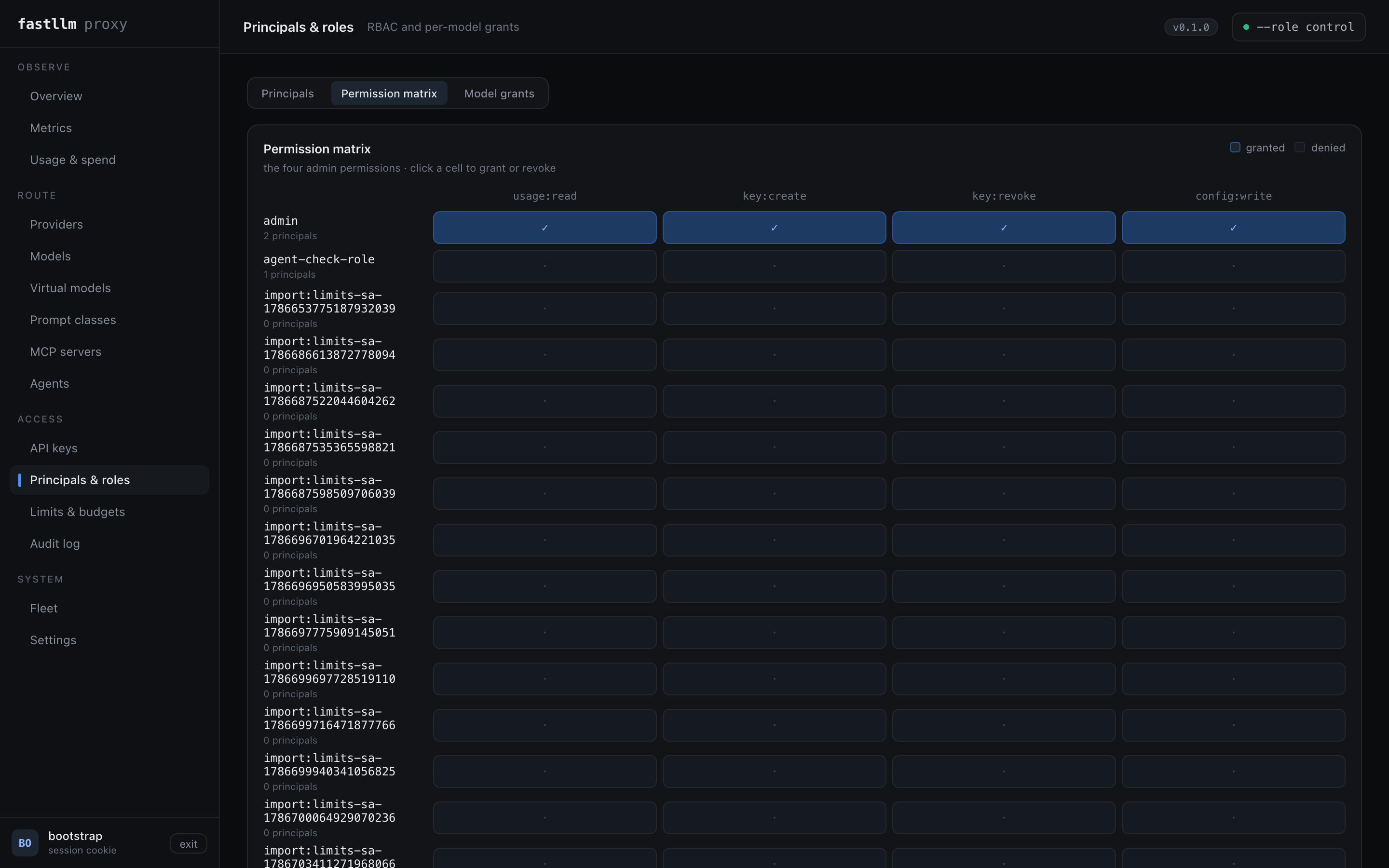
A valid session establishes who is calling. Every /admin/* handler then
checks what that principal may do:
| permission | |
|---|---|
config:write | Models, backends, frontend models, principals, roles, limits |
key:create / key:revoke | API keys |
usage:read | Usage, spend, audit, metrics |
model:invoke | Per model, and the only one the data plane checks |
A principal that can log in is not, by that fact, an administrator. This closed a real gap: any principal a password had ever been set for used to be a full admin, because nothing checked past "is this a valid session".
A grant on a frontend model covers the chain it routes to. A frontend model is how a model is exposed, so it is what gets granted, and a request naming one is authorised against it.
The trade that comes with it, stated plainly: adding a target to a frontend
model extends the reach of everyone holding it, with no new grant on record.
What makes that acceptable is that editing a frontend model requires
config:write, which is all-or-nothing and already lets its holder grant
themselves any model outright — so it is not a route to anything they could not
take directly.
The rule it replaced required a grant on the resolved provider model. That pinned every grant to a provider model's name, so renaming one revoked access with nothing reporting it — which migration 0029 did on the dev cluster, to two live roles. Provider models are not client-facing names at all now, so a frontend model cannot be bypassed by naming what it routes to.
What is stored, and in what form
| stored as | readable back? | |
|---|---|---|
| API keys | SHA-256 hash + prefix | No. Plaintext shown once at creation |
| User passwords | Argon2id | No |
| Session tokens | random, server-side | No |
| Upstream provider credentials | AES-256-GCM at rest | Not through the API — only whether one is set |
No route returns a credential. api_keys.hash is a verifier, not a
display value, and is in no response body.
upstream_api_key is the one secret that cannot be reduced to a hash — the
proxy has to present it to the backend as a bearer token — so it is encrypted
with FASTLLM_ENCRYPTION_KEY (32 bytes, openssl rand -hex 32) before it
reaches Postgres, and --role control/all refuses to start without the key
rather than falling back to plaintext.
Be precise about what that buys: it protects the database, not the
snapshot. Someone with read access to Postgres — a backup, a replica, a
leaked pg_dump — no longer gets every upstream credential for free. It does
nothing about /snapshot, which necessarily carries the credential in usable
form.
The one boundary to get right
/snapshot returns decrypted upstream credentials to anything holding the
proxy token, because the data plane cannot present a credential it cannot
read. Three consequences, and they are not negotiable:
- The admin port must never share an address with the gateway. Its callers hold inference keys and have no business reaching it.
/snapshotmust be TLS wherever a backend has a real credential.--tls-cert/--tls-key, and--ca-bundleon the proxy side for a privately-issued certificate.- The proxy token is a credential-bearing secret, not a service
discovery detail. Generate it (
pt-$(openssl rand -hex 24)), keep it in a Secret, and rotate it like one.
Exposing the admin Service at all rests on three properties holding together:
a session-authenticated admin API, TLS, and a private network. Take away any
one and it should go back to ClusterIP. The manifests in deploy/ say so
where the decision is made, rather than here where nobody applying them would
read it.
Every change is recorded
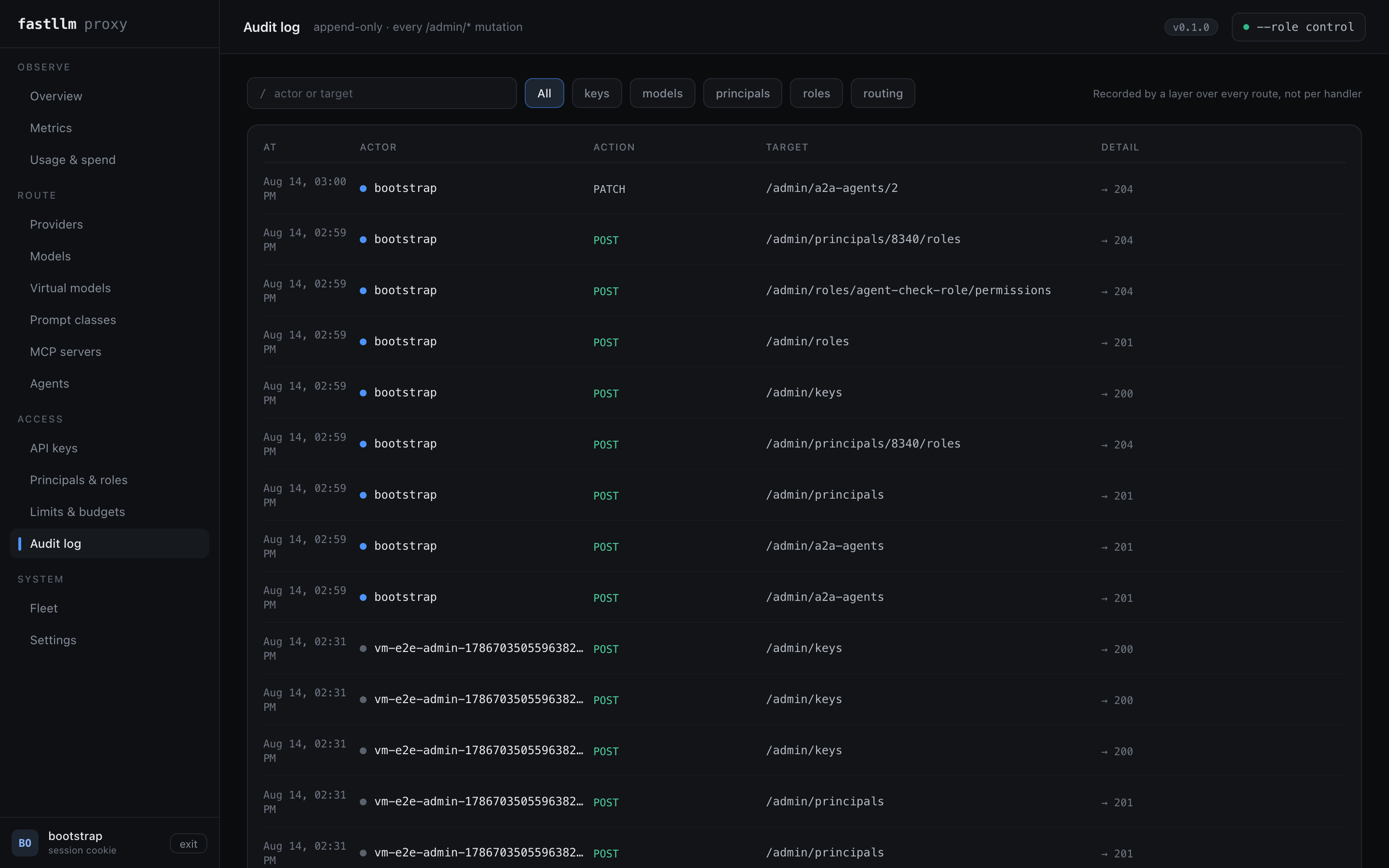
Every mutating admin call is audited before it is written, with the actor and the target. Three absences are deliberate:
- Reads are not recorded. It answers "what changed", not "who looked".
- Rejected attempts are not recorded. A 403 wrote nothing, and an audit log that fills with them is one nobody reads.
- The request body is never captured. It carries passwords and upstream credentials, and an audit log is exactly the wrong place to put them.
A failed audit write never fails the request. Losing a row is serious; losing the change and the record of it is worse.
Defaults that are deliberately inconvenient
| No default password | A fresh database has no login anyone can obtain. set-password is run once by whoever already holds cluster access |
--host is loopback | Binding 0.0.0.0 is an act |
| Keys expire in 90 days | Not "never" |
| A new principal holds nothing | Its key authenticates, then gets 403 on everything until it is given a role |
--role proxy is the default | The role that needs no database, no encryption key, and no admin surface |
Reporting something
Security issues go to the repository's private advisory form rather than a public issue. If a claim on this page is false, that is itself the report — this repository has shipped a doc claiming credentials were encrypted before they were, and it was review that caught it, not the author.
Where next
| API and administration | Route-by-route detail, and the session cookie's flags |
| Operations | Which deployment shape puts what on the public port |
| Architecture | Where each check happens, and why none of them is I/O |