A2A agents
One address in front of every agent. The same argument as the MCP gateway, one step further out: an agent acts — it runs, it calls tools, it spends money — so "which of our keys may set which agent running" is a question somebody eventually has to answer.
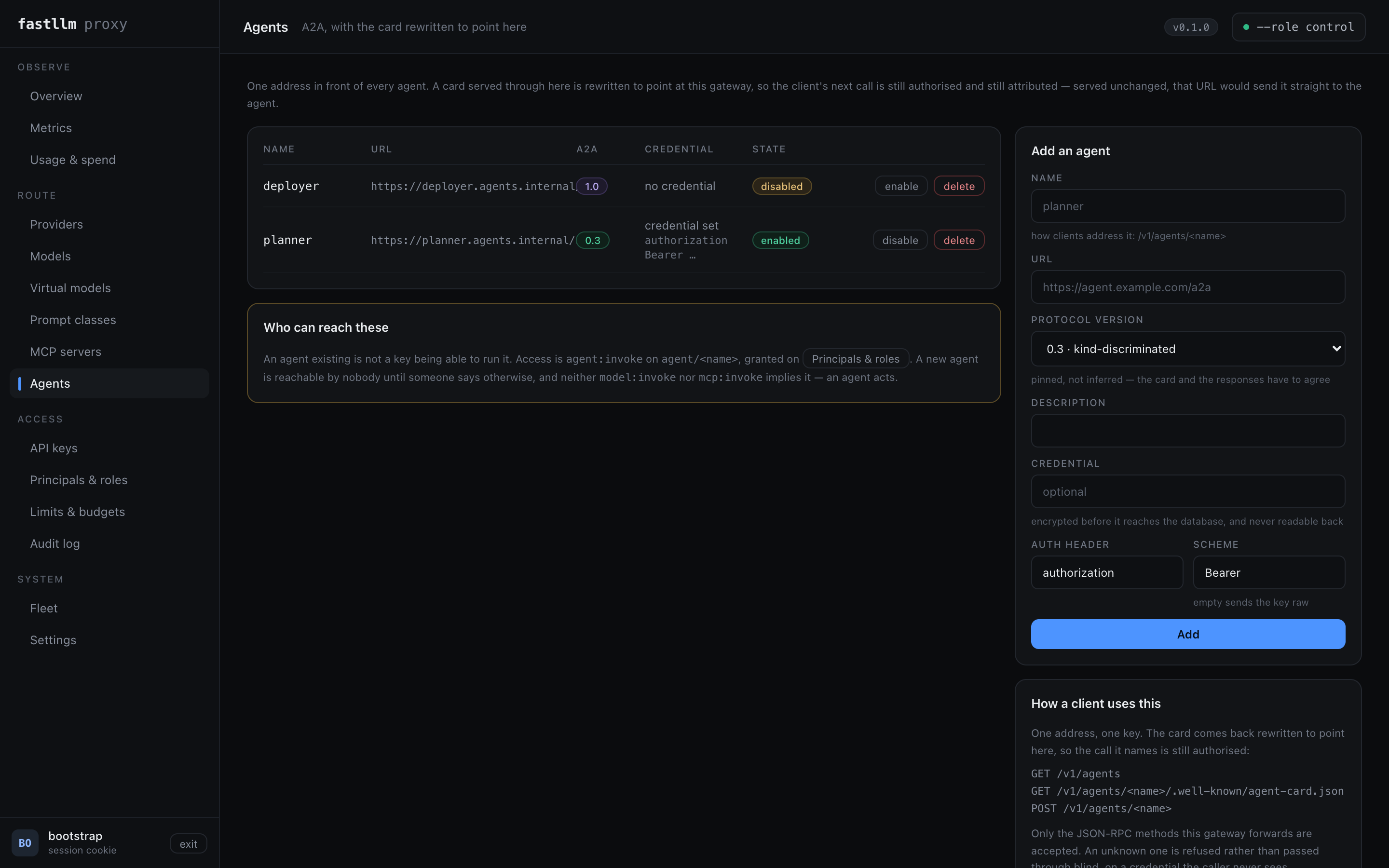
Add one on Agents, or by API:
curl -sk -b /tmp/ck -X POST https://control:4001/admin/a2a-agents \
  -H 'content-type: application/json' -d '{
    "name": "planner",
    "url": "https://planner.agents.internal/a2a",
    "protocol_version": "0.3",
    "upstream_api_key": "..."
  }'
| field | |
|---|---|
name | Addressed as /v1/agents/<name> |
url | The agent's A2A endpoint |
protocol_version | 0.3 or 1.0, pinned — see below |
auth_header / auth_scheme | As for any upstream; "" sends the credential raw |
upstream_api_key | Encrypted at rest, never readable back |
Calling one
# What this key may run.
curl -H "authorization: Bearer sk-..." http://gateway:4000/v1/agents

# The card — rewritten to point here.
curl -H "authorization: Bearer sk-..." \
  http://gateway:4000/v1/agents/planner/.well-known/agent-card.json

# Every JSON-RPC method, on one path.
curl -XPOST http://gateway:4000/v1/agents/planner \
  -H "authorization: Bearer sk-..." -H 'content-type: application/json' \
  -d '{"jsonrpc":"2.0","id":1,"method":"message/send",
       "params":{"message":{"role":"user","parts":[{"kind":"text","text":"plan it"}]}}}'
The card is rewritten, and that is the point
A client fetches an agent card and then talks to whatever url it names.
Served unchanged, that URL is the agent — so the client's next request goes
straight past the key check and the spend attribution, and this becomes a
discovery service rather than a gateway.
The card served here names this gateway, and carries the agent's pinned
protocolVersion rather than whatever the upstream claimed. Everything else
in the card is passed through untouched.
The gateway's address is taken from the request's Host rather than
configured: a deployment sits behind a Service, a VIP, an Ingress and a
port-forward at different times, and one configured base URL is wrong for
three of those.
Versions are pinned, never inferred
A2A 0.3 discriminates objects by kind. 1.0 uses protobuf JSON envelopes with
PascalCase method names. A gateway can infer which one a client wants from
the method it called, and LiteLLM does — but an inference means the agent card
can say one thing while the response is the other, and a client that has
already branched on the card is then wrong in a way that looks like the agent
misbehaving.
So the version is a column. This gateway forwards; it does not translate between versions. If your agent speaks 0.3 and your client wants 1.0, that is a translator, and it is not written. Stating that is the point — a gateway that silently half-does it is worse than one that does not.
Only known methods are forwarded
| 0.3 | 1.0 |
|---|---|
message/send, message/stream | SendMessage, SendStreamingMessage |
tasks/get, tasks/list, tasks/cancel, tasks/resubscribe | GetTask, ListTasks, CancelTask, TaskSubscription |
agent/getAuthenticatedExtendedCard | GetAgentCard |
Anything else is a 400. An unknown method forwarded blind is a request whose
effects nobody here can describe, made with a credential the caller never
sees. Adding one is a line of code, once somebody can say what it does.
message/stream is forwarded without being buffered, the same as a completion
— inspecting it would defeat streaming for exactly the same reason.
Access
curl -sk -b /tmp/ck -X POST https://control:4001/admin/roles/agents/permissions \
  -H 'content-type: application/json' -d '{"verb":"agent:invoke","resource":"agent/planner"}'
agent/* for every agent. Neither model:invoke nor mcp:invoke implies
it — an agent acts, and being allowed to call a model or read a tool server
says nothing about that. The seeded inference role does not get it; only
admin does.
An agent the caller may not reach answers 404, exactly as one that does not
exist.
Where next
| MCP gateway | The same idea for tool servers |
| Security | Where the credential lives, and what /snapshot carries |
| Interactive API reference | The three routes and their responses |